
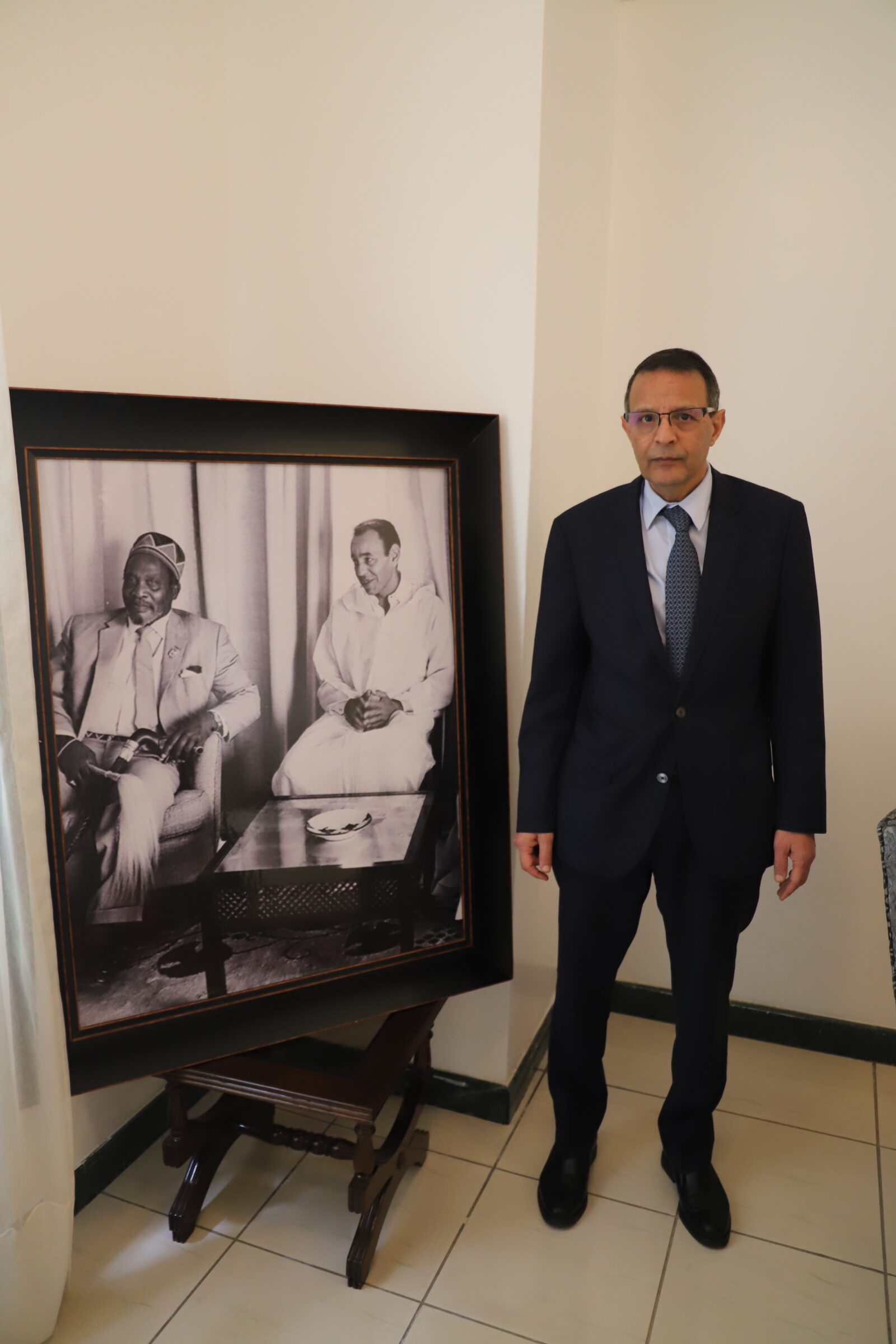
H.E. Amb. Abderrazak Laassel
Ambassador of the Kingdom of Morocco to Kenya
What inspired you to join the diplomatic service?
My diplomatic career began after I graduated from the National School for Public
Administration in 1986, where I specialised in diplomacy. Shortly after, I was recruited
by the Ministry of Foreign Affairs of Morocco. It has been a long and enriching journey.
I first spent six years in Switzerland as First Secretary at the embassy, before returning
to Rabat to work on cooperation with Central and Northern Europe.
I was later appointed First Secretary in Vienna, where I handled matters related to the
International Atomic Energy Agency (IAEA) and the Comprehensive Nuclear-Test-Ban
Treaty Organisation (CTBTO). In 2005, I moved to New York as a Minister dealing with
General Assembly affairs, a role I held for two years. In 2007, I was appointed Deputy
Permanent Representative in Geneva, where I worked on disarmament, humanitarian
affairs, and human rights.
I later returned to New York again as Deputy Permanent Representative until 2017,
when Morocco rejoined the African Union. At that point, I was appointed Director for
African Union Affairs, Maghreb Arab Union Affairs, and Maghreb countries, a position I
held for nearly four years. In December 2021, His Majesty the King of Morocco
appointed me Ambassador to Kenya.
Briefly, how does the Kingdom of Morocco operate politically?
Morocco is one of the oldest kingdoms in the world, with its history dating back to 788.
The country has been ruled by successive dynasties, and the current monarch is a
descendant of the Alaouite dynasty, which began in 1668. We operate as a constitutional
monarchy. The Head of Government is appointed by the King from the party that wins
parliamentary elections, after which the cabinet is formed, approved by the King, and
endorsed by Parliament following the presentation of its programme.
What was your reaction when you were appointed Ambassador to Kenya?
I was extremely excited. During my time as Director for African Union Affairs, I
travelled extensively across the continent but unfortunately never had the opportunity
to visit Kenya. Kenya is globally known for its beauty and well-protected wildlife. I had
also read about Kenya and watched films such as Out of Africa, which made the country
famous worldwide. Additionally, through my diplomatic career, I had interacted with
Kenyan diplomats, which further deepened my understanding of the country. Although
the pandemic delayed many things, I arrived in Kenya just one week after my
appointment.
Morocco attracts millions of tourists annually. How has the country
achieved this?
Before the pandemic, Morocco welcomed around 20 million tourists annually. This
success is largely due to the country’s diversity, which allows tourism to thrive
throughout the year. Tourism is one of Morocco’s major economic pillars. Visitors are
drawn by Moroccan hospitality, cultural openness, and ease of connectivity with Europe
and other regions.
We are located at the crossroads between Africa and Europe and have strong
infrastructure, including some of the best hotels in the world. Morocco has six historic
imperial cities, such as Rabat and Marrakesh, and is home to Al-Qarawiyyin University
in Fez—founded in 859 AD—which is considered the oldest existing university in the
world.
We also host major film studios in Ouarzazate, where many international movies have
been filmed, attracting global visitors. Tourism in Morocco is not seasonal—mountain
tourism thrives in winter, beach tourism in summer, and cultural tourism all year
round. Strong road networks, airports across major cities, water infrastructure such as
dams, and long-term planning have been key contributors to this growth.
Tourism, however, does not develop on its own. It must be part of a global national
strategy that includes infrastructure, education, security, agriculture, water
management, and sustainability. This integrated approach enabled Morocco to grow
from two million tourists in 2005 to 20 million in 2019.
Some perceive Morocco as being closer to Europe and the Arab world than
Africa. Is this accurate?
For Morocco, Africa is one continent—there is no North, West, or South. African
solidarity is central to our diplomacy. During the pandemic, Morocco rapidly converted
its industries to produce masks and ventilators, which we distributed freely across the
continent.
South–South cooperation is a pillar of Moroccan foreign policy. We are among Africa’s
leading investors, with over 1,000 cooperation agreements across the continent.
Although Morocco withdrew from the Organisation of African Unity in 1982, we
returned to the African Union in 2017. His Majesty the King stated then that Morocco
was not seeking leadership over Africa, but Africa’s leadership.
While we maintain strong ties with Europe, the US, Arab countries, and Latin America,
Africa remains our priority. Our particularly close relationship with West Africa is
rooted in history, religion, and shared cultural ties through the Tijaniyya order, which
originated in Fez in the 16th century.
What historical or cultural links do Kenya and Morocco share?
One of our shared links is Ibn Battuta, the 14th-century Moroccan explorer who
travelled extensively across Africa and documented his journeys in the Rihla. Mombasa
features prominently in his writings. We hope to establish an institute in Mombasa in
his honour to celebrate this shared heritage.
What plans do you have for strengthening Morocco–Kenya relations?
There is much we can learn from each other. Kenya has strong expertise in ICT and
wildlife conservation, while Morocco can share its experience in agriculture,
fertilisers—we are Africa’s largest exporter—and port management through the Tangier
Med Port, the largest in Africa and the Mediterranean.
We also have capacity in affordable housing development and industrial cooperation.
Currently, we are already collaborating with counties such as Baringo, Mombasa, and
Kisumu in areas including culture, tourism, and industrial training. Our aim is to
deepen practical cooperation that benefits both countries.
