

Kenya’s digital payment ecosystem is often hailed as one of the most advanced in the world. With over 47 million mobile money users and a penetration rate of more than 90 percent, the country has become a global case study in financial innovation.
However, even with the innovations, at its core, Kenya’s payment ecosystem is vast but disjointed. Mobile money platforms, bank transfers, card payments, and a growing number of fintech wallets operate alongside each other, each with its own infrastructure, interfaces, and costs. For businesses, this often means juggling multiple systems, different tills, devices, and accounts, to accommodate customers. For users, it translates into inconsistent experiences, varying transaction fees, delays, and, at times, outright payment limitations.
“You find that if I have a card, in many places I’m not able to pay. And if I don’t have mobile money, I’m also locked out of certain parts of the economy,” said Johnson Ondicho, Head of digital Channels KCB Group. “All these platforms are segmented.”
This fragmentation has broader implications. It slows down reconciliation processes, increases operational costs, and limits transparency. In some cases, it even sustains reliance on cash, ironically in one of the most digitized payment environments in Africa, because users and merchants opt for the simplest, most predictable option.
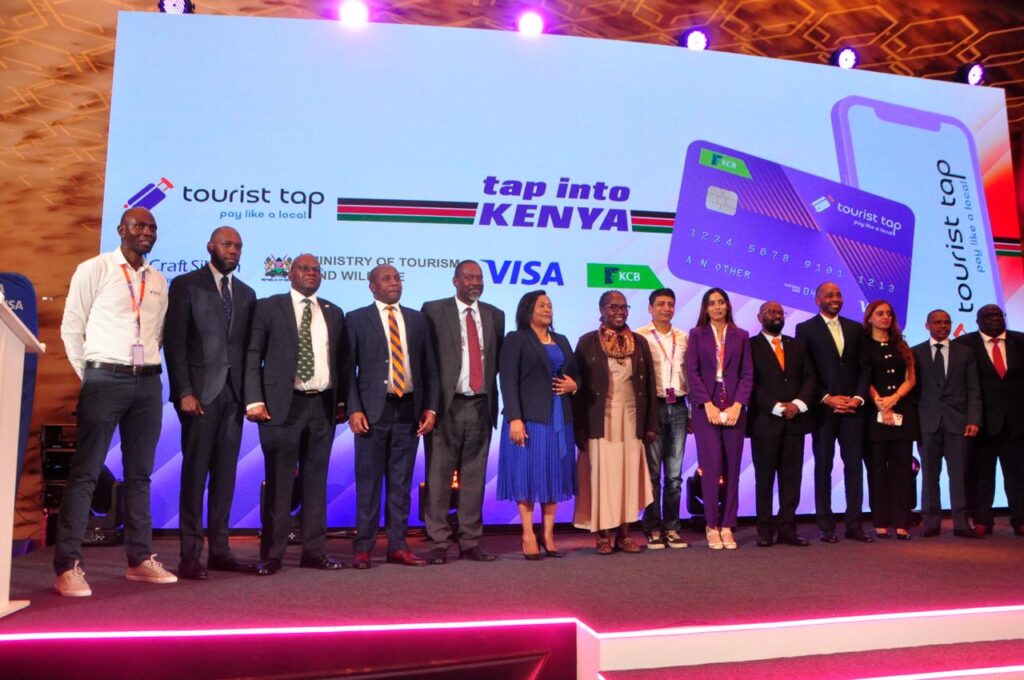
For a sector like tourism, where seamless experiences define destination competitiveness, these inefficiencies can be costly. To cover this gap, innovators are coming up with innovations to make the payment experience seamless particularly for travelers. One of the apps is the newly launched travel-focused payment platform, TouristTap. Developed by Craft Silicon in partnership with KCB Bank and Visa, TouristTap introduces a unified, cashless payment ecosystem designed specifically for travelers.
“Tourism remains one of Kenya’s top foreign exchange earners, generating approximately KES 500 billion in 2025 and supporting close to three million jobs. But as global travel evolves, so do visitor expectations. Today’s traveler expects frictionless, cashless transactions, whether paying for a safari, a hotel stay, or a tuk-tuk ride along the coast,” said Tourism and Wildlife Cabinet Secretary Rebecca Miano at the launch. “The platform is “timely and transformative solution” and aligns with Kenya’s push toward a fully digital tourism economy,” she added.

The platform enables users to make payments across multiple touchpoints, from airports and hotels to national parks, local markets, and informal traders, using a single interface. By integrating mobile money rails with international card systems, TouristTap allows travelers to pay directly from NFC-enabled smartphones, eliminating the need for local SIM cards, currency exchange, or cash handling. A visitor can simply tap their device, enter a local till number or paybill, and complete the transaction securely using a PIN.
“For tourists, it’s about removing the stress of figuring out how to pay,” said Kamal Budhabhatti, CEO of Craft Silicon. “They don’t need to convert currency or rely on someone else to transact on their behalf. Everything becomes seamless.”
The platform also addresses a long-standing structural issue in Kenya’s payment ecosystem: the high cost of card acceptance.
Traditionally, card payments have been limited to large, high-end businesses due to the cost of point-of-sale (POS) machines. This has effectively excluded small and medium enterprises, the backbone of Kenya’s tourism value chain, from participating fully in digital commerce.
“What this innovation has done is reduce the cost significantly by turning a phone into a payment device,” explained Ondicho. “Now even small traders whether in markets, salons, or roadside stalls, can accept card payments.”
This shift is expected to democratize payment acceptance, bringing more players into the formal financial system while enhancing convenience for travelers.
Fred Kagwa, CEO of the Kenya Association of Tour Operators, pointed to the platform’s potential to transform how tourism businesses operate, particularly through features like referral-based incentives and seamless payment sequencing.
“This is a game changer,” he said. “It’s not just about payments but about how operators participate in the digital economy and capture value across the tourism chain.”
Global payment giant Visa, a key partner in the initiative, emphasized the role of payments in shaping overall travel experiences.
“Tourism is one of Kenya’s most important economic engines, and how visitors pay is a critical part of that experience,” said Chad Pollock, Visa’s Vice President for East Africa. “When payments are seamless and secure, it enhances trust, improves efficiency, and ultimately drives higher spending.”
Beyond transactions, the platform also opens up new possibilities for data-driven decision-making. Through payment insights, tourism stakeholders can better understand visitor behavior, spending patterns, and peak travel periods enabling more targeted marketing and smarter investment strategies.

However, even as more innovators seek to make payment easier, challenges still remain.
“Cost of transactions continues to be a concern, particularly for small businesses. There is also the question of adoption ensuring that both merchants and consumers are not only aware of the platform but also comfortable using it. Financial literacy, infrastructure gaps, and system reliability will all play a role in determining its success. The future of Kenya’s payment ecosystem lies in integration, not proliferation,” explained Ondicho.
