

Comic journalism, also known as graphic journalism, is a powerful form of visual
storytelling that blends the depth of investigative reporting with the accessibility and
emotional resonance of comics. Pioneered by figures like Joe Sacco, this genre has
allowed audiences to engage with complex, often underreported issues such as war,
displacement, and human rights abuses in a more immersive and empathetic way.
Unlike traditional journalism, comic journalism captures nuance through facial
expressions, setting, and body language, while also giving voice to people whose stories
might otherwise be overlooked. Its impact has been global: from depicting the horrors of
the Bosnian War and the Israeli-Palestinian conflict, to exploring Indigenous struggles
in Canada or refugee experiences in Europe. By humanizing statistics and headlines,
comic journalism not only informs but also challenges readers to see the world
differently.
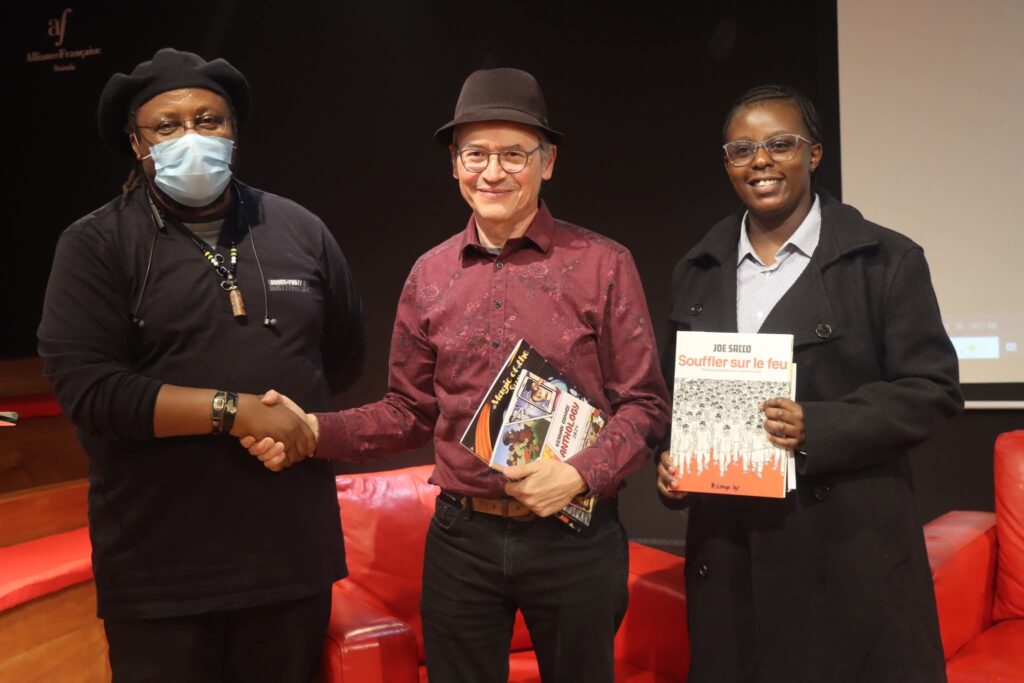
At the recent Reveal Comics Conversation EA, the Maltese-American cartoonist and
journalist talked about his journey and his work, often centered on war zones, political
conflict, and marginalized voices, has reshaped what both journalism and graphic novels
can do. Through stark black-and-white illustrations and relentless commitment to truth,
Sacco has turned the comic book into a vessel for uncomfortable, urgent realities.
Born in Malta, raised in Australia, and educated in the United States, Sacco initially
trained as a traditional journalist.
“I wanted to be a news writer,” he recalls. But the jobs I encountered after graduating
were unfulfilling, leading me back to my childhood hobby—drawing comics.”
In the early 1990s, comics were still viewed largely as entertainment for children or
superhero fans. Sacco’s early work consisted of short pieces published in independent

anthologies, paying just a few dollars per page. That changed when he decided to merge
his journalistic training with his artistic instincts. Drawn by a deep interest in the
Middle East, Sacco traveled to the West Bank and Gaza to document the lives of
Palestinians under Israeli occupation.
“What began as a travelogue quickly evolved into something more rigorous. I conducted
interviews, observed daily life, and absorbed the emotional texture of conflict like a
journalist. The result was Palestine, a nine-part comic series published between 1993
and 1995,” he narrates.
Though it sold poorly at the time, it was eventually compiled into a single volume that
won the American Book Award in 1996, signaling a shift in how the literary and
journalistic worlds viewed comics.
Sacco’s reputation grew with Safe Area Goražde (2000), an unflinching look at the
Bosnian War, followed by The Fixer (2003) and Footnotes in Gaza (2009), which won
the Ridenhour Book Prize. In 2020, he released Paying the Land, an investigation
into the lives of the Dené people in Canada and their complicated relationship with
resource extraction, colonial history, and climate change.
Though his topics are weighty—war, displacement, systemic injustice—Sacco’s method
is intimate and human. He listens. He observes. He includes his own uncertainties and
questions in the narrative.
“I try to represent people and events in a way that the people there will feel: ‘Okay, I
might not like this, but I can’t say it’s not true,’” he explains.
In Footnotes in Gaza, for instance, Sacco included scenes of celebration in Gaza after a
bombing in Tel Aviv—a choice he made despite sympathizing with the Palestinian cause.
“That’s why I’m not an activist,” he says. “I have to be honest about what I’m seeing.”


Sacco’s visual style is raw and detailed. His refusal to adopt digital tools has become part
of his aesthetic identity.
“I never learned to use Photoshop,” he says, preferring the tactile satisfaction of pen
and ink. He draws in black and white, partly out of habit and partly as a limitation-
turned-style. Early influences like Robert Crumb shaped his initial cartoonish,
exaggerated style, which later evolved into a more realistic approach out of respect for
the people he portrayed—and in recognition of the power of images to stereotype.
“If it’s journalism, it has to have a pretense to realism,” he says.
His books are often text-heavy, a reflection of his original ambition to be a writer. Still,
the images carry immense power.
“When I handed my book Palestine to older people in Gaza, they understood what I was
doing immediately. If it were prose, they might not even be able to read it—but the
images translated.”
That power, he notes, is also why cartoonists often face censorship or backlash.
“Cartoons don’t need translation. They go straight to the point.”
Despite his international acclaim, Sacco remains candid about the struggles of the
profession. He notes how difficult it still is to make a living, particularly outside the
mainstream comic book markets. He also advises young cartoonists to retain ownership
of their original work—he now sells his older pieces to supplement his income.
Sacco is currently working on a long-form book and recently released The Once and
Future Riot, exploring violence between communities in Ethiopia. While awards and
acclaim have followed him, Sacco maintains that the greatest reward is simple:
“The fact that I can make a living at it—that’s really good. That’s kind of my award,” he
concludes.
