
On December 6 th 10 pm this year, Ambassador Ryoichi Horie received a message from
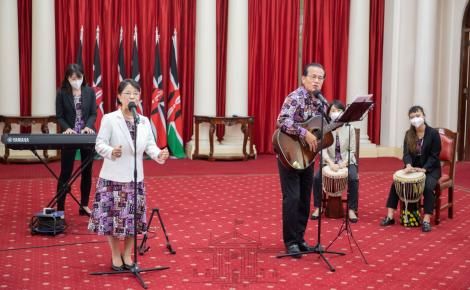
the PS of foreign affairs, Amb. Macharia Kamau, that his request to perform before the
president with his wife during his last courtesy call as the Japanese ambassador in the
country, was granted. This was a rare chance to do so since the president never meets
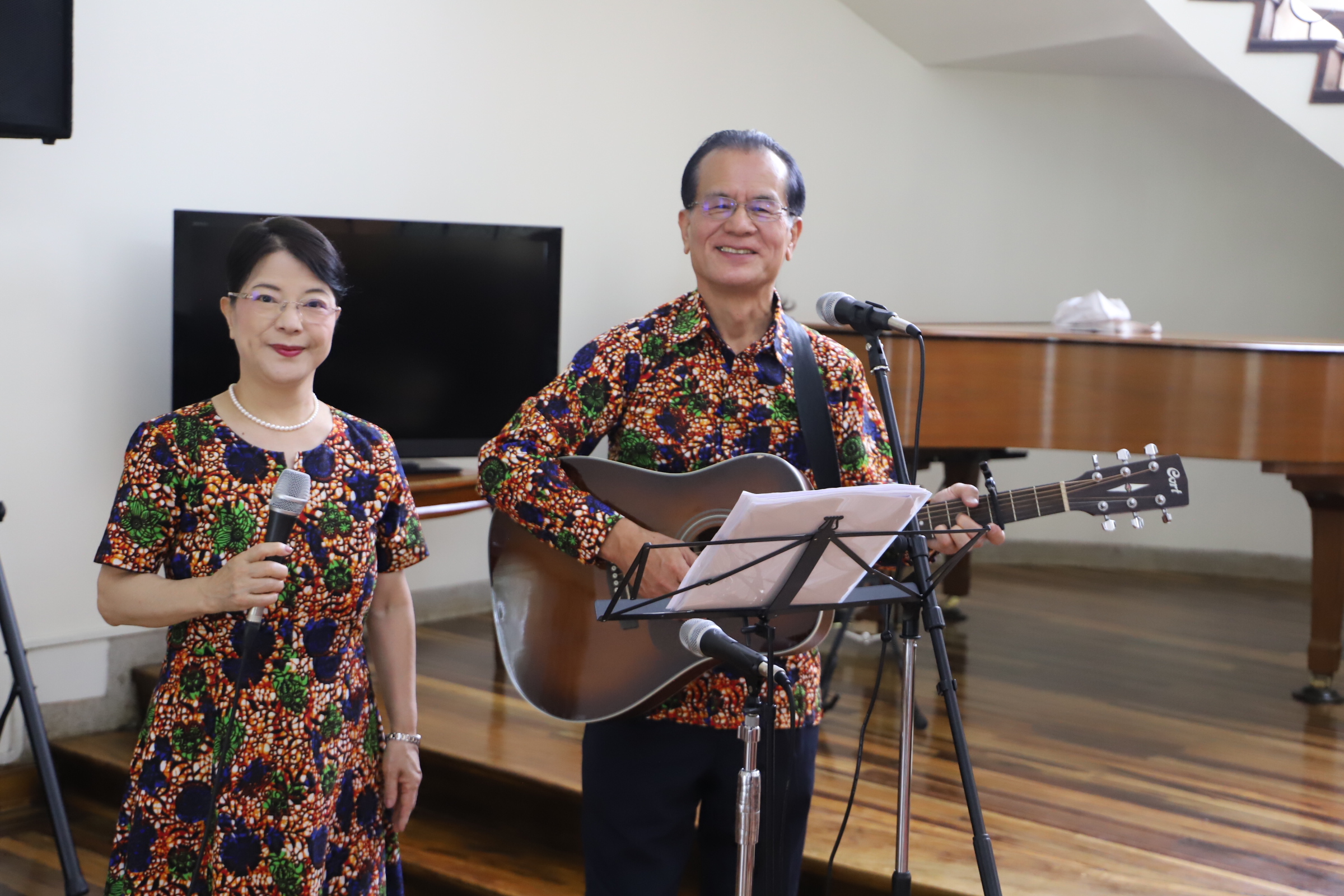
an outgoing ambassador. Armed with their guitar, piano and two drums, the
ambassador and his wife sang not one but two songs to the president. To crown it all,
the performance was one of the trending ones on You tube with over 100,000 likes so
far.
“I would say that we were lucky to have that special and rare opportunity to sing before
the president. I appreciate the president for allowing me and my wife to do that,” says
the elated diplomat.
He further reveals that the opportunity came after several unsuccessful attempts to sing
at various events. The first one was during the final trials of the Kenyan Olympians
where the ambassador and his wife were supposed to sing for the athletes at state house
just before they traveled. Sadly, planned changed due to time restrictions and the Covid
19 regulations.
“I attended the event but made sure that I told the president that I wanted to sing with
my wife during my courtesy call with him. I’m so happy that he honored my request,”
Unknown to many, the couple’s singing journey didn’t begin at this event. While his wife
had the passion to sing since her childhood, Amb. Royichi too knew how to play the
guitar and hum a few tunes but didn’t not take the passion seriously until in 2016 while
on a mission in the Federal state of Micronesia. They had invited a small acapella
singing group from Japan to celebrate thirty year bilateral relationship with the country
and as they belted out their melodies, the couple was shocked not only by their
melodious voices but how the crowd responded to the music.
“Music is a source of joy for everybody and that’s when we decided to start singing in
front the public starting with the president of Micronesia. When we came here, we
started thinking of playing the guitar and singing songs and always waited for the
opportune time to do so,” recalls the soft spoken Madame Yuko.
The singing couple came to Kenya on 4 th July 2019 when the ambassador received his
appointment. It was not their first time in the country though, since 38 years ago, they
were here for their honeymoon and spent their holiday in Nairobi and Amboseli while
Amb. Ryoichi was a young diplomat in Nigeria. After working in Nigeria, he worked in
Tokyo under various departments, one of which was an African one which made him
tour the country in many occasions mainly business. So far, he has toured 20 African
countries and was happy by his appointment to the country as an ambassador. While
every country he has been an ambassador has its own challenge, Kenya is a bit more
stable and he feels, it needs more appreciation from the international community. And
to bring harmony of cultures, the two brought music as part of the package. They began
singing every time they launched a project in the 15 counties that they have toured. In
one, at Masaai Mara, they sang so well till the elders gave them new names: Madame
Yuko was given Nashipai (the happy one) while Ryoichi was given Memusi (the lucky one).
In 2019, their moment to sing before a larger crowd came in Mombasa during the
launch of Japanese ODA projects in Mombasa, including Mombasa (Dongo Kundu)
Special Economic Zone Development Project.
“After the speech, I noticed that people were dissatisfied that I had just spoken in
English and not added a few Swahili words so to break ice, I called my wife and we
began singing an acapella English song and they all applauded. And that’s when we
understood that singing songs in Kenya was great in connecting with people,” recalls the
ambassador.
The ambassador notes that the experience motivated them to learn and practice more
Swahili songs, first starting with Jambo bwana and Malaika. Then last year, a Kenyan
friend taught them Eric Wainaina’s song, dubbed Daima Mimi Mkenya.
“We were told that it was sung when Kenya faced its worst political crisis in 2007. So we
practiced that song and another embassy staff specialist, who is a Swahili specialist, who
explained to us the lyrics of the song and we were so moved by how patriotic the lyrics
were,” says Amb Royichi.
He adds that they were advised by the embassy’s media specialist to get the copy right of
the song from Eric Wainaina and the search to find him began. Several months later,
they were able to meet him and their wish was granted.
“We sang part of Daima in front of him as acapella in October last year and he was so
surprised and accepted that we sing his song. We invited him too for our farewell
reception, and had a joint session with him singing the song. He uploaded our joint song
to his you tube channel,” says Madame Yuko.
How the two met
The lovebirds met in 1975 in Tokyo at a mutual friend’s party. Madam Yuko was 16 years
and still in high school old while the ambassador was 20 years, and a university student.
They became friends but in 1979, the ambassador began working in the foreign service
and was posted in the UK for his first mission.
“Though we were not yet engaged, we had feelings for each other and knew that we
would one day tie the knot,” narrates the ambassador’s wife.
“We didn’t have the internet at that time but we would send each other airmails every
week. We have boxes full of them in Tokyo.”
During this period, Madam Yuko was studying Education at the University and when
she finished, the ambassador couldn’t wait any longer and asked her for her hand in
marriage on phone as he was miles away from home. In 1982 they got married and even
though Madam Yuko had the love of her life, she realized that there was so much to
learn about being a diplomat’s wife.
“I was just from university so I had no chance to train on how to do house chores. I was
worried that I couldn’t even cook for my husband something that I had to learn through
cook books and him training me till I perfected my skill,” she continues.
On top of that, Madam Yuko learnt Ikebana, which traditionally is the classical art of
Japanese flower arranging. She also learnt the traditional Japanese tea ceremonies and
how to wear a kimono, Japanese traditional outfit.
“My mother bought for me a wonderful kimono and I trained how to wear one. I also
trained how to cook because as the wife of a diplomat we host many guests at the
residence.”
The couple has three children aged 36, 32 and 24. While the ambassador admits to be
the disciplinarian, his wife is the soft one. Life as a diplomat raising them was not as easy as it looks since they had to move with their children 17 times. In one incident, their son refused to travel to Canada where the ambassador had been posted in 2000 and the two had to take him to a boarding school in Tokyo.
“One of the most challenging bit for diplomats is the education of their children.
Each child has their own opinion on what they wanted to do. Though it was a difficult
life of adjusting to a new one every now and then, after several years they have learnt to
appreciate the travels and the experiences now that they are older. My two daughters
have settled in Tokyo and have no need to travel again,” explains the ambassador.
Their eldest son is now a diplomat something that the ambassador is proud of since he
now has someone who they can talk common issues with. His wife is also happy to train
her daughter in law on being a diplomat’s wife. Their second daughter is an elementary
school teacher, something that the diplomat’s wife always desired to do. The younger
daughter too is a junior high school Home economics teacher. The couple had another
daughter, who sadly passed away in 1995 at the age of seven of brain cancer while they
were on a mission in New York. As the ambassador recalls, this was one of the toughest
moments in his life as a diplomat.
“You need time and lots of it to heal from such pain and I don’t think anyone gets over
such pain. We had hope that since the US has the highest level of health care, she would
be okay but she didn’t make it. She had a surgery thrice, chemo therapy and radiation
many times and even a bone marrow transplant. But many American friends helped us
by being with us in the hospital and assisting us whenever we needed assistance.
We still keep in touch with some of them via email.”
Since this is his last mission, the ambassador and his wife are both ecstatic about their
next life. Amb. Ryoichi hopes to become a visiting lecturer in one or many of the
universities where he has been corresponding and pass on his much-needed wisdom
gathered within his 43 years in the diplomatic field to the next generation of diplomats.
“We have only one language in Japan, and while there are different cultures in different
areas, it’s a homogenous society. It is a great occasion to think about diversity, and so
being out makes them think of other cultures. My long years outside were a great
opportunity to understand my culture, my society, and background, and now it’s time for
me to teach young students based on my experience of the world and Japan. The
current chapter is completed, and I will move to another chapter of my life,” he says.
They also plan to spend more time with their four grandchildren, and for his wife, her
She desires to resume her teaching career.
“I have a license for teaching ikebana, so that is what I want to train others in Japan. I
started learning about this when I was 23 years old and, step by step, gained my experience
and licenses. The final one I got from an Indian teacher while my husband was on a
mission there,” she says in conclusion. Supporting young musicians and other creatives. One of his biggest dreams is to establish a professional recording studio in his home area, so upcoming artists do not have to endure the same financial and logistical barriers he faced.
